



Automation is the Backbone of the One-Person Business in 2026, because you are literally doing everything by yourself, and to meet customer demand, you will need assistance. Running a one-person business in 2026 is no longer about working harder or longer hours. It is about working smarter, building systems, building an online portfolio, and letting technology handle repetitive tasks while you focus on growth, creativity, and decision-making. The information and internet era has created endless opportunities for solo entrepreneurs, freelancers, creators, consultants, and service providers, but it has also increased competition and customer expectations. Clients now expect faster responses, consistent delivery, professional communication, and around-the-clock availability, even from solo operators.
Here are some of our popular posts: Top 10 best website builders, Best super foods for a healthy lifestyle, the unlimited list of free productivity apps, Best freelance site to find remote jobs, top 10 productivity hacks for entrepreneurs , 10 best side hustles to make extra money online, best online courses for learning digital skills, top 10 best free coding website
This is where the ability to Use Automation to run a One-Person Business becomes a critical advantage rather than a luxury. Automation allows one person to operate like a small team by handling marketing, sales, customer support, content distribution, payments, scheduling, and reporting without constant manual input. In fact, many successful solo founders in 2026 run six-figure businesses with no employees, relying almost entirely on automated systems.
Automation does not replace human creativity or strategy. Instead, it removes friction, reduces burnout, and creates time freedom. When set up correctly, automation works quietly in the background, ensuring your business runs smoothly even when you are offline. This article will walk you through how to strategically Use Automation to run a One-Person Business in 2026, covering mindset, tools, workflows, and practical implementation across your entire operation.
Understanding Automation and the One-Person Business Model in 2026
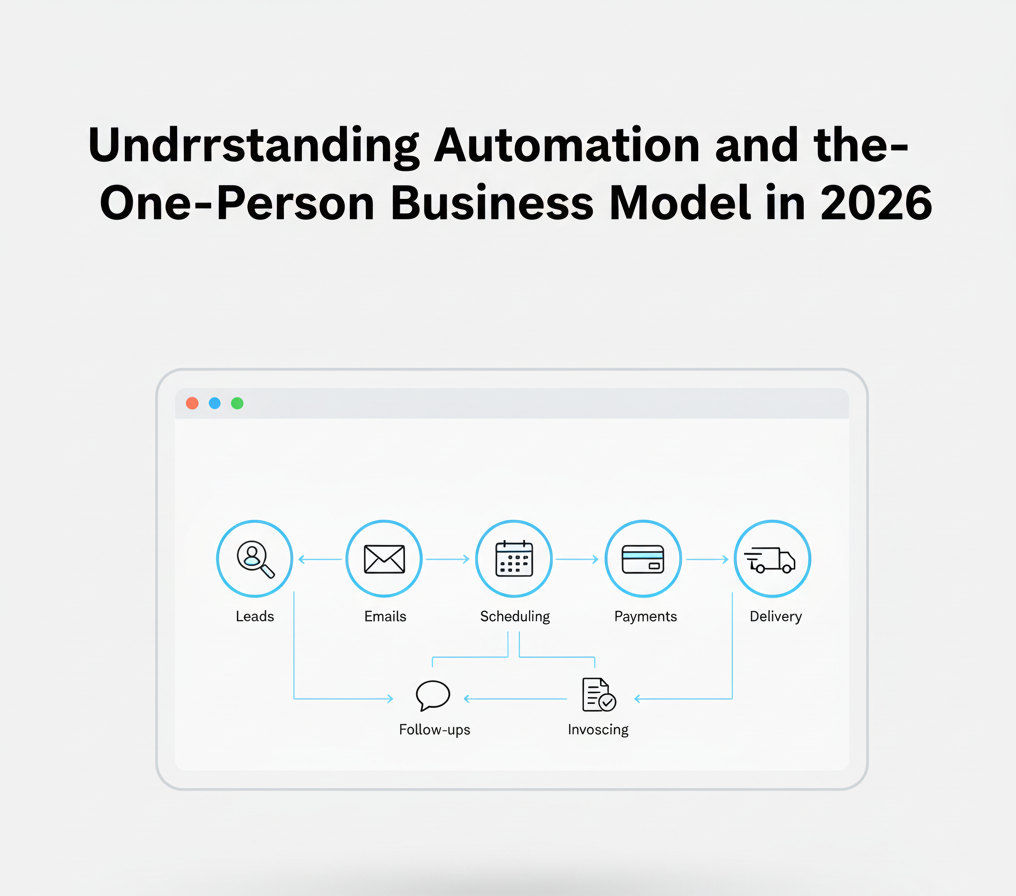
To effectively Use Automation to run a One-Person Business, it is important to first understand what automation really means in today’s context. Automation is the use of software, tools, and workflows to complete tasks automatically based on predefined rules or triggers. In a one-person business, automation replaces manual labor, repetitive decision-making, and constant switching between tools.
The one-person business model in 2026 is built around leverage. Instead of trading time for money, solo entrepreneurs design systems that scale without additional human resources. Automation allows you to sell digital products, deliver services, onboard clients, follow up with leads, and nurture customer relationships without being physically present for every step.
For example, when someone visits your website, automation can capture their email address, send a welcome message, deliver a free resource, segment them based on interest, and introduce them to a paid offer. All of this can happen while you are asleep. This level of efficiency is what allows solo founders to compete with larger teams.
ALSO READ: The Best AI Email Assistants to save Time in 2026
Another key shift in 2026 is the integration of AI into automation. Modern automation tools no longer rely only on rigid rules. They can analyze behavior, personalize messaging, predict outcomes, and optimize workflows in real time. This means automation is no longer cold or robotic. When done well, it feels personal, responsive, and intelligent.
Core Areas Where You Should Use Automation to Run a One-Person Business

Not every part of a business should be automated, but there are core areas where automation delivers massive returns. Understanding where to focus your efforts will help you build a lean and efficient operation.
Marketing automation is one of the most impactful areas. This includes email marketing, lead generation, social media scheduling, and content distribution. Instead of manually sending emails or posting content every day, automation allows you to create campaigns once and let them run continuously. Email sequences can educate prospects, build trust, and sell your offers on autopilot.
Sales automation is equally important. Automated sales funnels, checkout systems, payment processing, and digital product delivery remove friction from the buying process. When a customer decides to purchase, everything should happen instantly without your involvement. This not only improves customer experience but also increases conversion rates.
Customer support automation helps solo business owners avoid burnout. Chatbots, help desks, knowledge bases, and automated responses can handle common questions, order confirmations, and onboarding instructions. While complex issues may still require your attention, automation filters out repetitive requests.
Operations and admin automation includes invoicing, expense tracking, contract signing, appointment scheduling, and project management. These tasks do not generate revenue directly, but they consume time. Automating them frees up mental space and reduces errors.
Analytics and reporting automation give you visibility into what is working and what is not. Automated dashboards can track sales, traffic, email performance, and customer behavior, allowing you to make informed decisions without manual data collection.
Step-by-Step Guide to Using Automation Across Your One-Person Business

To successfully Use Automation to run a One-Person Business, you need a structured approach rather than randomly adopting tools.
Step 1: Map Your Entire Business Workflow from Start to Finish
The foundation of effective automation is clarity. Before using any tool, you must understand how your business currently operates. Begin by writing down every recurring task you perform weekly or monthly. This includes content creation, lead generation, email follow-ups, client onboarding, product delivery, customer support, reporting, and even financial tasks.
Do not rush this step. The goal is to see your business as a system rather than a collection of random activities. Map the full customer journey, starting from the moment someone discovers your business to the point where they become a paying customer and receive ongoing support. This workflow map becomes your automation blueprint and prevents you from automating the wrong processes.
Step 2: Identify Tasks That Are Ideal for Automation
Once your workflow is mapped, review it carefully and highlight tasks that are repetitive, predictable, and time-consuming. These are the best candidates for automation. In a one-person business, anything that requires the same action repeatedly should not be done manually.
Examples include sending onboarding emails, confirming appointments, delivering digital files, issuing invoices, and following up with leads. These tasks do not require creative thinking each time, which makes them perfect for automation. By identifying and prioritizing these activities, you free up time for strategic work such as marketing, product development, and customer relationships.
Step 3: Choose the Right Tools for Each Function
With clarity on what needs to be automated, the next step is selecting the right tools. In 2026, many platforms offer all-in-one solutions, but using specialized tools often delivers better performance and flexibility. The key is choosing tools that integrate smoothly with each other.
For example, an email marketing platform should connect easily to your CRM, payment processor, and scheduling tool. This allows data to flow automatically between systems. Avoid choosing tools in isolation. Instead, think in terms of an ecosystem where each tool plays a specific role while working together through integrations or workflow automation platforms.
Step 4: Build Simple Automation Workflows First
A common mistake solo founders make is trying to automate everything at once. This often leads to confusion and broken systems. The best approach is to start small. Build one simple automation, test it, and refine it before moving on to more complex workflows.
For example, begin with automating lead capture and a welcome email sequence. Once that works smoothly, you can expand into automating onboarding, sales funnels, or customer follow-ups. Simple workflows are easier to troubleshoot and help you build confidence in your automation setup. Over time, these small systems combine to form a powerful automated business engine.
Step 5: Test Every Automation from the User’s Perspective
Testing is a critical step that should never be skipped. Every automation must be tested as if you were the customer. Sign up as a lead, book an appointment, or make a test purchase and experience the entire process yourself.
Pay attention to timing, clarity, and accuracy. Are emails sent at the right time? Is the messaging clear and helpful? Are there any broken links or missing steps? Testing allows you to catch errors early and ensures a smooth experience for your audience. In a one-person business, a well-tested system protects your reputation and builds trust automatically.
Step 6: Document Your Automation Systems for Consistency
Even though you are running a one-person business, documentation is essential. Write down how each automation works, which tools are involved, and what triggers each workflow. This documentation does not need to be complex, but it should be clear and organized.
Documenting your systems makes it easier to update, improve, or replace tools in the future. It also prepares your business for scaling, outsourcing, or collaboration if needed. Most importantly, documentation ensures consistency. When your systems are documented, your business runs smoothly even when you take breaks or shift focus.
By following these steps, you create a structured and sustainable approach to automation. This is how successful solo entrepreneurs use automation to run a one-person business efficiently in 2026 without burnout or overwhelm.
Common Automation Tools and Systems for One-Person Businesses in 2026
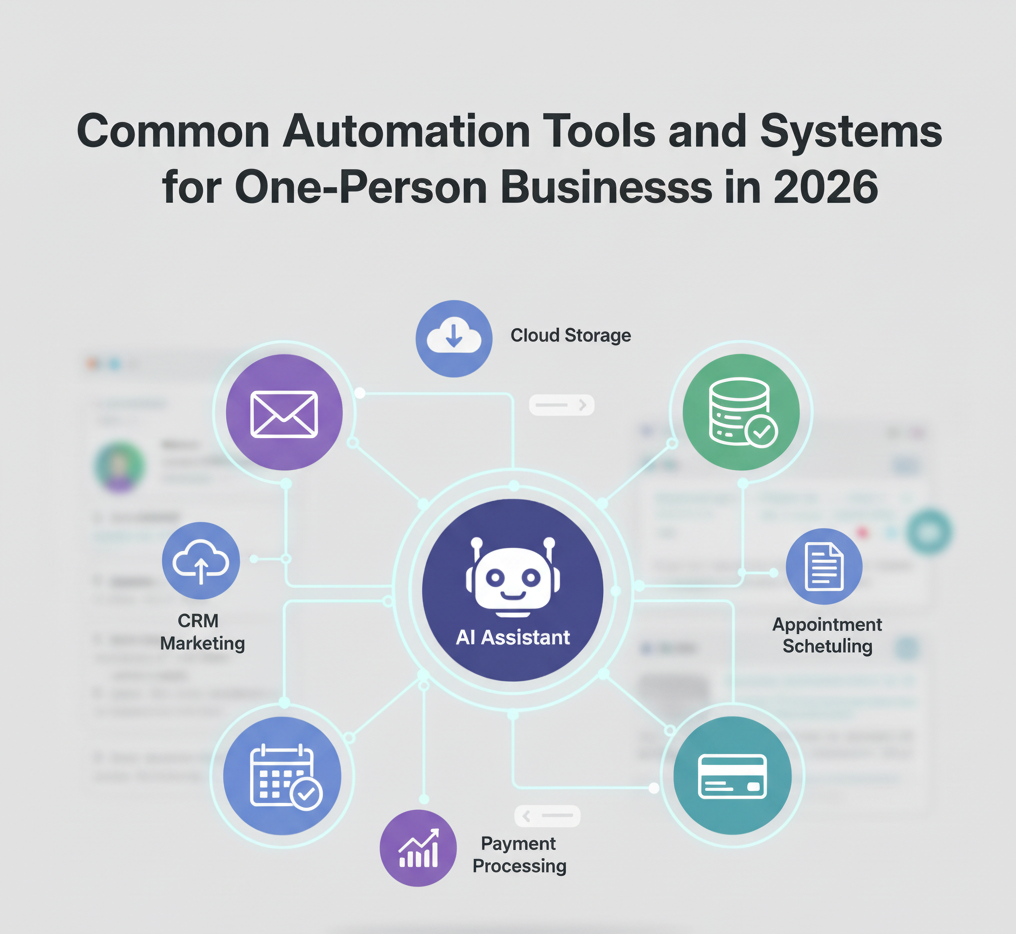
#1. Email Automation Tools
Email automation tools are one of the most important systems in any one-person business because email remains the highest converting communication channel. In 2026, these tools will go far beyond sending newsletters. They manage automated welcome sequences, drip campaigns, lead nurturing flows, product launches, and customer onboarding without manual effort.
The key role email automation plays is relationship building at scale. Once someone joins your email list, the system can automatically introduce your brand, educate them about your offers, answer common objections, and guide them toward a purchase. Modern email automation platforms use behavioral triggers such as link clicks, purchases, and browsing activity to personalize messages. This ensures every subscriber receives content that is relevant to their interests, even though the system runs automatically. For a one-person business, this means consistent communication and sales without daily manual work.
#2. Customer Relationship Management Systems
Customer relationship management systems, commonly known as CRMs, are essential for organizing and managing every interaction with leads and customers. In a one-person business, it is impossible to remember every conversation, preference, or follow-up timeline manually. A CRM solves this problem by centralizing all customer data in one place.
The role of a CRM is to act as the memory of your business. It tracks emails, purchases, support requests, and engagement history. In 2026, modern CRMs also automate follow-ups, segment contacts based on behavior, and trigger actions such as sending reminders or assigning tasks. For solo founders, CRMs reduce mental load and prevent missed opportunities. Instead of worrying about who to follow up with, the system ensures no lead or customer falls through the cracks.
#3. Workflow Automation Platforms
Workflow automation platforms are the backbone of a fully automated one-person business. These tools connect all your software and allow them to communicate automatically. Their importance lies in eliminating manual handoffs between systems.
The role of workflow automation is to trigger actions based on events. For example, when a customer completes a payment, the system can automatically create a customer profile, send a receipt, grant access to a digital product, add the buyer to an email sequence, and update your accounting records. Without workflow automation, each of these steps would require manual effort. In 2026, these platforms are smarter and more flexible, allowing solo entrepreneurs to design complex systems that operate reliably in the background.
#4. Scheduling and Appointment Booking Tools
Scheduling tools play a critical role in protecting time and reducing communication friction. One of the most time-consuming tasks for a one-person business is coordinating meetings, consultations, or coaching sessions through endless email exchanges.
The role of scheduling automation is to allow clients to book appointments based on real-time availability without your involvement. These tools automatically handle confirmations, reminders, cancellations, and rescheduling. In 2026, scheduling platforms will also integrate with calendars, video conferencing tools, and payment systems. For solo entrepreneurs, this means fewer interruptions, fewer no-shows, and more control over daily schedules.
#5. AI-Powered Automation Tools
AI-powered tools have become game changers for one-person businesses in 2026. These tools enhance automation by adding intelligence, personalization, and speed. Unlike traditional automation that follows fixed rules, AI tools can analyze context, learn patterns, and adapt responses dynamically.
The role of AI automation includes content creation, customer support, data analysis, and decision support. AI assistants can draft emails, generate marketing copy, summarize customer conversations, respond to support inquiries, and create reports. For solo operators, AI reduces cognitive load and accelerates execution. It allows one person to perform tasks that previously required multiple roles, such as writer, analyst, and support agent.
#6. Accounting and Finance Automation Tools
Accounting and finance automation tools are critical for maintaining financial clarity and compliance in a one-person business. Financial tasks are often neglected by solo founders because they feel complex and time-consuming. Automation removes this barrier.
The role of finance automation tools is to handle invoicing, payment tracking, expense categorization, tax calculations, and financial reporting automatically. In 2026, these systems will integrate seamlessly with banks, payment processors, and sales platforms. This reduces errors, ensures accurate records, and saves hours of manual bookkeeping. For a one-person business, financial automation provides peace of mind and allows the founder to focus on revenue-generating activities rather than administrative stress.
Best Practices, Mistakes to Avoid, and How to Scale with Automation
While automation is powerful, it must be used intentionally. One best practice is always to prioritize user experience. Automation should make interactions smoother, not colder. Personalization, clear communication, and easy opt-out options are essential.
Another best practice is regular review and optimization. Automation workflows should not be set and forgotten. As your business evolves, your systems should evolve with it. Review performance metrics and adjust accordingly.
A common mistake is over-automation. Not every interaction should be automated. High-value clients or sensitive conversations often require a human touch. Balance efficiency with authenticity.
Another mistake is tool overload. Using too many tools increases complexity and costs. Choose tools that integrate well and serve multiple functions where possible.
As your one-person business grows, automation becomes the foundation for scaling. You can launch new products, enter new markets, and serve more customers without increasing workload. At this stage, automation allows you to remain a one-person business by choice, not limitation.
Conclusion: Use Automation to Run a One-Person Business
Learning how to Use Automation to run a One-Person Business in 2026 is not about removing yourself from your business. It is about designing a company that supports your lifestyle, protects your energy, and amplifies your impact. Automation allows you to focus on strategy, creativity, and meaningful work while systems handle the rest.
Here are some of our popular posts: Top 10 best website builders, Best super foods for a healthy lifestyle, the unlimited list of free productivity apps, Best freelance site to find remote jobs, top 10 productivity hacks for entrepreneurs , 10 best side hustles to make extra money online, best online courses for learning digital skills, top 10 best free coding website
The most successful solo entrepreneurs are not the busiest ones. They are the ones with the best systems. By strategically applying automation across marketing, sales, operations, and support, you can build a profitable, sustainable, and scalable one-person business that thrives in 2026 and beyond.
If you want more practical guides like this, including tool breakdowns, real-world workflows, and step-by-step strategies for solo entrepreneurs, make sure to return to our blog regularly. Automation is not the future. It is the present, and those who master it now will lead tomorrow.
