



Productivity has always been a moving target. What worked five years ago may feel outdated today, and what is effective today may struggle tomorrow. As we move deeper into 2026, distractions are no longer limited to social media notifications. AI tools, remote work, gig schedules, creator economies, and information overload have fundamentally changed how we work.
Here are some of our popular posts: Top 10 best website builders, Best super foods for a healthy lifestyle, the unlimited list of free productivity apps, Best freelance site to find remote jobs, top 10 productivity hacks for entrepreneurs , 10 best side hustles to make extra money online, best online courses for learning digital skills, top 10 best free coding website
In this fast-evolving environment, one debate keeps resurfacing among entrepreneurs, professionals, creators, and knowledge workers: time-blocking vs. task-batching. Both methods promise focus, efficiency, and better output. Both have loyal advocates. And both can either transform your workflow or completely frustrate you if used incorrectly.
This article breaks down Time-Blocking vs Task-Batching in a practical, real-world way. We will explore what each method really means, its advantages and disadvantages, and finally compare them using real productivity data and modern work realities to determine which approach boosts productivity more in 2026.
Understanding what time-blocking is

Time-blocking is a productivity method where you divide your day into specific blocks of time, and each block is assigned a specific task or category of work. Instead of working from an open-ended to-do list, you work from a structured calendar.
For example, instead of saying “I will work on content today,” you assign 9:00 am to 11:00 am for writing, 11:00 am to 12:00 pm for emails, 1:00 pm to 2:30 pm for meetings, and so on. When the time block ends, you stop and move to the next scheduled activity.
Time-blocking forces intentionality. Every hour of your day has a job. This method became mainstream through high-performance professionals, executives, and creators who needed to manage multiple responsibilities without burning out.
In 2026, time-blocking has evolved beyond simple calendars. Many professionals now use AI-powered scheduling tools, smart calendars, and automation systems that dynamically adjust time blocks based on workload, energy levels, and deadlines.
Top 5 advantages of time-blocking
#1. It eliminates decision fatigue: One of the biggest productivity killers is deciding what to work on next. Time-blocking removes that problem entirely. When your day is planned, you are not constantly asking yourself what to do next. You simply follow the schedule.
Research in behavioral psychology consistently shows that decision fatigue reduces mental performance as the day progresses. Time-blocking protects your mental energy by reducing unnecessary choices.
#2. It improves focus and deep work: Time-blocking creates protected focus periods. When you assign a block specifically for one task, especially high-concentration work like writing, coding, or strategy, you are more likely to enter a state of deep work.
In a 2024 productivity survey involving remote workers and digital professionals, individuals who used structured time blocks reported fewer interruptions and higher task completion rates than those working from flexible to-do lists.
#3. It creates realistic expectations: Many people overestimate how much they can accomplish in a day. Time-blocking forces realism. You can clearly see how much time is available and how long tasks actually take.
This visibility helps prevent overcommitment and burnout, which are increasingly common in the always-on work culture of 2026.
#4. It improves work-life boundaries: Time-blocking makes it easier to define when work starts and ends. When personal time is also blocked intentionally, it becomes harder for work to spill into evenings and weekends.
This is especially valuable for freelancers, remote workers, and entrepreneurs who struggle with separating work from personal life.
#5. It integrates well with modern tools: In 2026, time-blocking works seamlessly with AI schedulers, digital calendars, project management tools, and automation systems. Tasks can be automatically scheduled, rescheduled, or reprioritized without manual effort.
This makes time-blocking scalable for complex workloads and fast-changing priorities.
Top 5 disadvantages of time-blocking
#1. It can feel rigid: One of the most common complaints about time-blocking is that it feels too strict. When unexpected tasks or emergencies arise, a tightly planned schedule can feel frustrating.
Not everyone thrives under rigid structures, especially creative professionals who rely on flow and spontaneity.
#2. Interruptions can derail the system: Time-blocking assumes a certain level of control over your environment. In reality, meetings run late, urgent messages appear, and clients make unexpected demands.
When interruptions happen frequently, time blocks can collapse, leaving people feeling behind and stressed.
#3. It requires upfront planning time: Effective time-blocking requires planning your day or week. For some people, this planning process itself feels like extra work.
If done poorly, the time spent planning can outweigh the productivity benefits.
#4. It may increase pressure: Seeing unfinished tasks as time blocks expire can create anxiety. Some people feel rushed, even when the task requires more time than anticipated.
Instead of improving productivity, this pressure can reduce performance for individuals who need flexibility.
#5. It is not ideal for reactive roles: Roles that involve constant responsiveness, such as customer support, community management, or crisis handling, may struggle with strict time-blocking.
In these cases, the unpredictability of work makes fixed schedules difficult to maintain.
Understanding what task-batching is
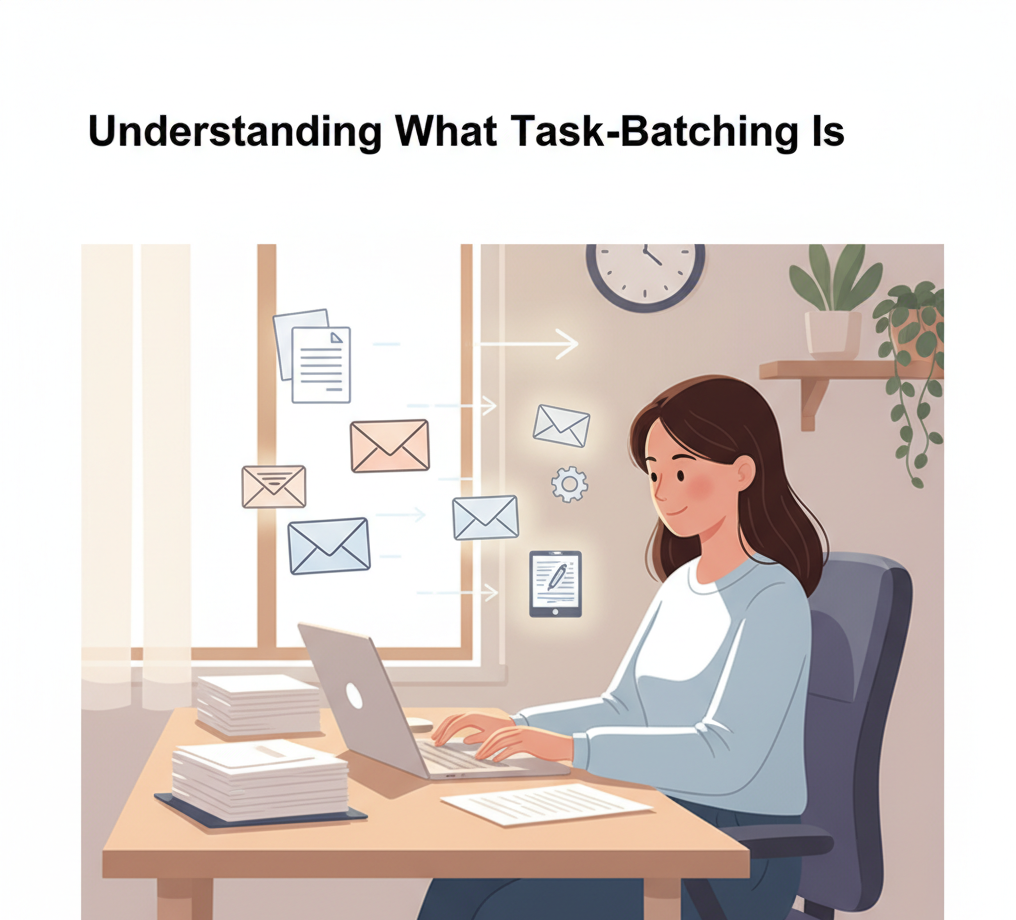
Task-batching is a productivity method where similar tasks are grouped and completed in one focused session. Instead of switching between different types of work, you batch similar activities to reduce context switching.
For example, instead of checking emails throughout the day, you batch all email responses into one or two dedicated sessions. Content creators might batch multiple videos or articles in one sitting. Administrators might batch invoicing, reporting, or data entry tasks.
Task-batching is rooted in cognitive science. The human brain performs better when it stays in the same mental mode rather than constantly switching between different types of tasks.
In 2026, task-batching has become especially popular among creators, solopreneurs, and AI-assisted workflows where repetitive or similar tasks can be optimized.
Top 5 advantages of task-batching
#1. It reduces context switching: Every time you switch between tasks, your brain loses momentum. Task-batching minimizes this by keeping your mind focused on one type of activity. Studies in cognitive productivity show that context switching can reduce efficiency by up to 40 percent. Task-batching directly addresses this issue.
#2. It increases speed and efficiency: When you repeat similar tasks, you naturally become faster at them. Whether it is writing, editing, outreach, or administrative work, batching allows you to build momentum. This is why factories, production lines, and even digital workflows rely heavily on batching principles.
#3. It works well for repetitive tasks: Task-batching is ideal for tasks that do not require constant creativity or decision-making. Emails, scheduling, content editing, data entry, and social media posting are perfect examples. In 2026, many professionals combine task-batching with automation to further speed up repetitive workflows.
#4 It feels more flexible: Unlike time-blocking, task-batching does not require strict scheduling down to the minute. You decide what tasks to batch and when to complete them. This flexibility makes it appealing to creatives and people with unpredictable schedules.
#5. It pairs well with energy management: Task-batching allows you to align tasks with your energy levels. You can batch creative work during high-energy periods and routine tasks during low-energy times. This approach feels more natural for many people.
Top 5 disadvantages of task-batching
#1. It can encourage procrastination: Without fixed time boundaries, some people delay starting batches, especially large or unpleasant ones. Tasks can pile up and become overwhelming.
#2. It may ignore priorities: Task-batching focuses on similarity, not importance. This can lead to spending too much time on easy tasks while critical work gets delayed. Without clear prioritization, productivity may suffer.
#3. Long batches can cause fatigue: Working on similar tasks for extended periods can become mentally exhausting, especially for creative or analytical work. This can reduce quality over time.
#4. It lacks structure for complex schedules: Task-batching works best when you control your time. For people with meetings, deadlines, and external demands, batching alone may not provide enough structure.
#5. It can blur work boundaries: Without clear start and stop times, work can easily spill into personal hours, especially when batching at home.
Critical comparison of both methods: Time-Blocking vs Task-Batching
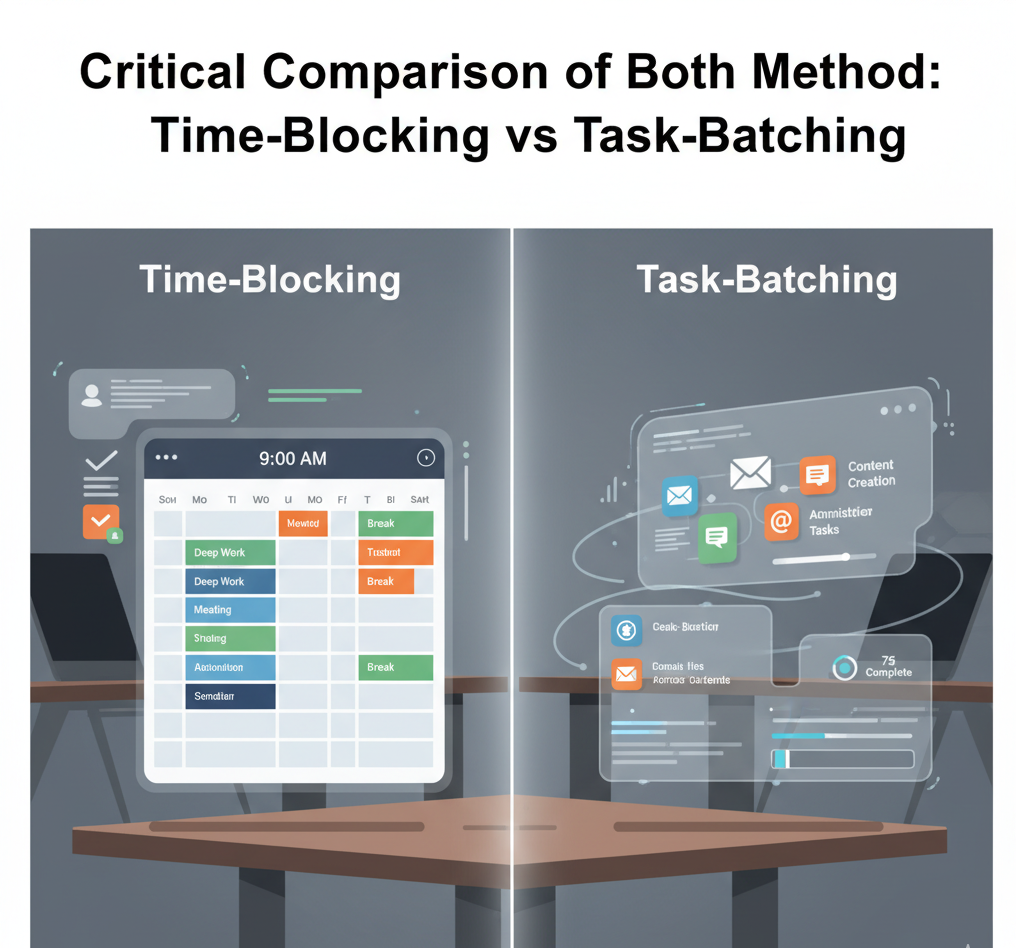
The debate around Time-Blocking vs Task-Batching is not about which method is good or bad. It is about which method performs better under modern work conditions.
Time-blocking excels in structured environments. It provides clarity, predictability, and accountability. Task-batching excels in efficiency and cognitive flow, especially for repetitive or
Real-world productivity data from remote work studies between 2023 and 2025 shows interesting patterns. Professionals who relied solely on to-do lists completed fewer priority tasks than those who used either time-blocking or task-batching.
However, workers who combined both methods strategically reported the highest productivity and lowest burnout rates.
Time-blocking performs better for roles that require coordination, deadlines, and meetings. Task-batching performs better for creators, freelancers, and roles with repetitive outputs.
In 2026, AI-assisted workflows favor hybrid systems. Many professionals now time-block their day into categories and task batches within those blocks.
Based on modern productivity research, workplace trends, and real-world usage patterns, time-blocking has a slight edge as the more effective standalone productivity method in 2026.
The reason is not efficiency alone. It is sustainability. Time-blocking consistently outperforms task-batching when it comes to prioritization, work-life balance, and long-term output.
That said, the highest-performing individuals do not choose between Time-Blocking vs Task-Batching. They combine them.
They use time-blocking to structure their day and task-batching to execute efficiently within those blocks. This hybrid approach aligns with how modern work actually happens.
Conclusion: Time-Blocking vs Task-Batching
The productivity landscape of 2026 demands intentionality. Distractions are smarter, workloads are heavier, and attention is more valuable than ever. The debate around Time-Blocking vs Task-Batching is ultimately about control.
Here are some of our popular posts: Top 10 best website builders, Best super foods for a healthy lifestyle, the unlimited list of free productivity apps, Best freelance site to find remote jobs, top 10 productivity hacks for entrepreneurs , 10 best side hustles to make extra money online, best online courses for learning digital skills, top 10 best free coding website
Time-blocking gives you control over your time. Task-batching gives you control over your focus. When used together, they create a powerful productivity system that adapts to modern work realities.
If you want to stay productive, profitable, and sane in 2026, stop chasing productivity hacks and start building systems that work for your lifestyle.
Some tips to maximize any productivity method: Start small and refine your system weekly, Track what actually works instead of copying influencers, Protect your focus from notifications and interruptions, Use tools that simplify, not complicate your workflow, Review your productivity weekly and adjust based on results, Productivity is not about doing more. It is about doing what matters, consistently, with clarity.
For more in-depth guides, tools, and strategies like this, explore more topics on our blog and stay ahead of productivity trends.
